Grants management: the complete guide for research institutions
What is grants management?
Grants management is everything an organization does to win, run, and close a grant. It starts before a proposal is written, with finding the right funding opportunity, and ends after the money is spent, when the final financial and progress reports are accepted and the account is closed.
For research institutions, grants management mostly means managing federal awards from agencies such as NIH and NSF. Those awards come with detailed rules about what money can be spent on, how effort is documented, which changes need permission, and when reports are due. Getting any of these wrong can mean disallowed costs, delayed funding, or audit findings, so grants management is as much about compliance as it is about paperwork.
It is also different from grant writing. A grant writer focuses on the narrative that wins the award. Grants management covers the budget, the administrative parts of the proposal, and everything that happens after the award is made.
The grants management process: four stages of the grant lifecycle
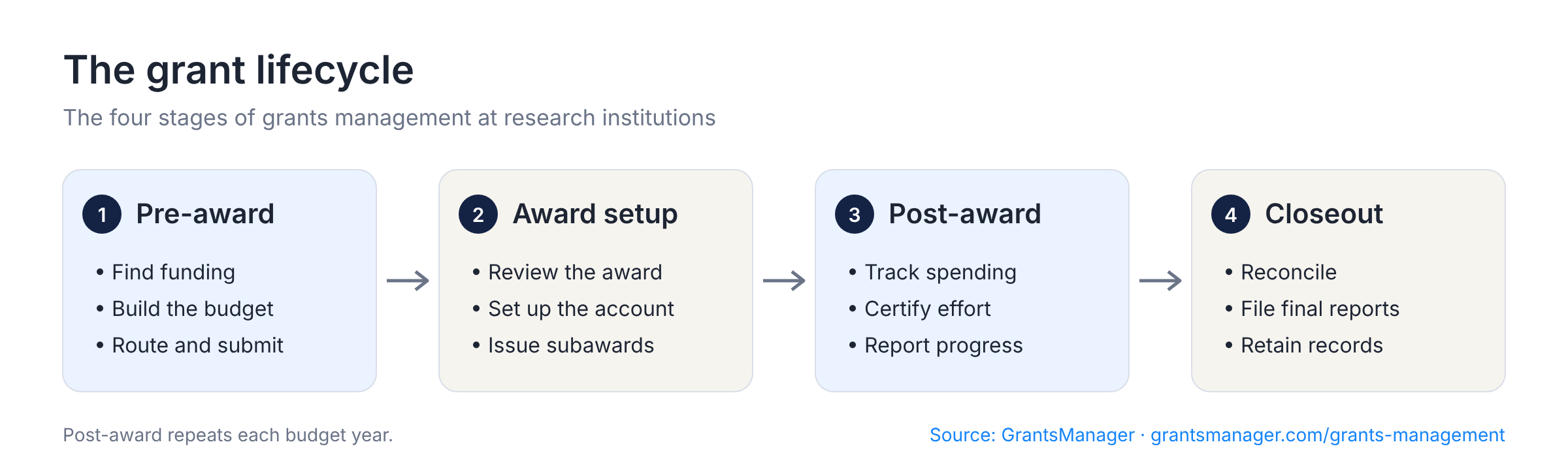
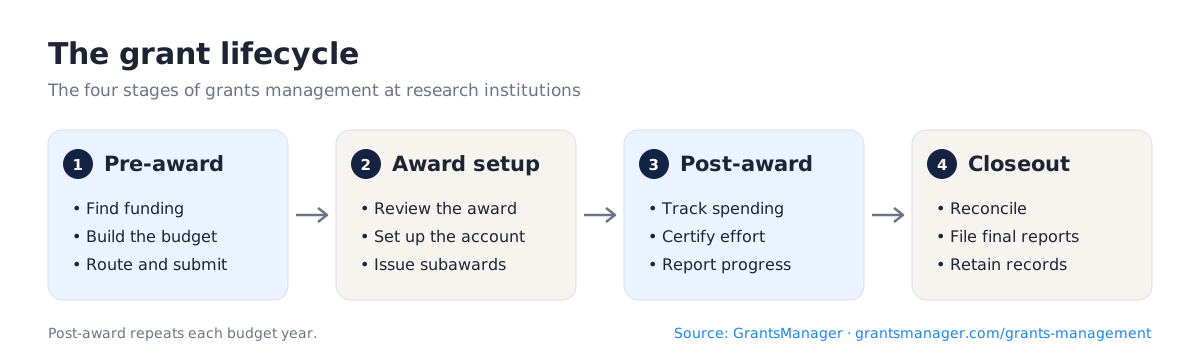
Every sponsored award moves through the same four stages. Information carries forward from one stage to the next: the budget built at proposal becomes the budget tracked after award, and the effort promised in the proposal is the effort certified later.
- 1.Pre-award
- 2.Award setup
- 3.Post-award
- 4.Closeout
Use this chart on your site or in training materials
Free to use with credit. Paste this HTML into your page, or download the image.
1. Pre-award grants management
Pre-award starts with finding a funding opportunity and reading the notice of funding opportunity (NOFO) for eligibility, deadlines, and budget limits. The grants manager builds the budget and budget justification, gathers biosketches and other support, and routes the proposal for internal approval. The sponsored programs office then submits it on behalf of the institution. Most institutions want the final proposal several business days before the sponsor deadline. Use the proposal submission checklist and browse grant opportunities to get started.
2. Award setup
When the sponsor decides to fund a proposal, it may first send just-in-time requests for updated other support and compliance approvals. The notice of award then sets the amount, the budget period, and the terms. Before any money is spent, compare the award with the proposal, set up the account and budget in the financial system, issue any subawards, and record every reporting date. The guide to reading a notice of award covers what to check.
3. Post-award grant management
Post-award is the longest stage and where most of the risk sits. It covers monthly review of spending against the budget, tracking the award's burn rate, certifying effort, correcting charges with cost transfers, requesting prior approval for significant changes, monitoring subrecipients, and submitting annual progress reports such as the NIH RPPR. Each accepted progress report releases the next year of funding.
4. Grant closeout
About 90 days before the end date, decide whether the work needs more time and a no-cost extension. At the end, collect final invoices from subrecipients, reconcile the account, remove any unallowable charges, and file the final financial report, final progress report, and invention statement. At NIH these are due within 120 days of the end date. The grant closeout checklist walks through each step.
Who manages grants? Roles in grants management
At universities and academic medical centers, grants management is shared. The principal investigator is responsible for the science and for how the money is spent, but most of the administrative work sits with a department grants manager, often called a research administrator, supported by central offices.
| Role | Main responsibilities |
|---|---|
| Principal investigator | Leads the science, approves the budget and charges, certifies effort, writes progress reports |
| Department grants manager | Builds budgets, prepares proposals, reviews spending monthly, prepares approval requests, reconciles at closeout |
| Sponsored programs office | Signs and submits proposals as the authorized organization representative, accepts awards, issues subawards |
| Grants accounting | Sets up accounts, invoices sponsors and draws down funds, files financial reports |
Grant timeline example: a new NIH R01
Grants management runs on long timelines. NIAID notes that the time from submission to project start is typically 10 to 12 months, and can reach 20 months if the application is resubmitted. A five-year R01 therefore spans six years or more from proposal to closeout. For exact deadlines, see the NIH standard due dates for 2027.
| When | What happens |
|---|---|
| Month 0 | Application submitted on a standard due date |
| Months 3 to 4 | Peer review by a study section |
| Months 6 to 8 | Advisory council review and just-in-time requests |
| Months 9 to 12 | Notice of award; account set up and spending begins |
| Every year | Annual RPPR, 45 days (SNAP) or 60 days (non-SNAP) before the next budget period |
| End + 120 days | Final financial report, final RPPR, and invention statement due |
Grants management regulations: the Uniform Guidance and sponsor policies
The foundation of federal grants management is the Uniform Guidance, published at 2 CFR 200. It sets government-wide rules for allowable costs, indirect costs, procurement, equipment, subrecipient monitoring, reporting, closeout, and the single audit. The current version is the 2024 revision, which applies to awards made on or after October 1, 2024, and raised several thresholds.
NIH is the main exception. In April 2026 (NOT-OD-26-072) NIH rescinded the 2024 changes to the indirect cost base and the de minimis rate, and said it will not apply the updated thresholds for now. NIH awards therefore count only the first $25,000 of each subaward in the F&A base. For other sponsors, use $25,000 unless your negotiated rate agreement adopts the 2024 amount of $50,000.
A further rewrite is pending. In May 2026 OMB proposed turning the Uniform Guidance into a binding "Uniform Grants Regulation" with broader termination rights and new certifications. The September 2026 continuing resolution bars OMB from finalizing it before December 11, 2026, so the 2024 rules remain in force for now. The Uniform Guidance quick reference has every threshold, the NIH differences, and the key sections in one place.
Each agency then adds its own terms. NIH publishes the NIH Grants Policy Statement, which includes the salary cap and NIH's prior approval rules. NSF publishes the Proposal and Award Policies and Procedures Guide (PAPPG), which includes the two-month salary rule for senior personnel. On top of those sit the terms in each notice of award and your institution's own policies, which are often stricter.
| Threshold | Current figure |
|---|---|
| Subawards in the MTDC base | First $25,000 of each subaward on NIH awards ($50,000 for other agencies only where your rate agreement adopts the 2024 amount) |
| Equipment | $5,000 per unit on NIH awards; $10,000 under the 2024 Uniform Guidance |
| De minimis indirect rate | 10% of MTDC on NIH awards; up to 15% for other agencies |
| Single audit | Required at $1,000,000 in annual federal spending |
| NIH salary cap | $228,000 for 2026 |
| Record retention | 3 years from the final financial report |
Grant compliance and prior approvals
Grant compliance means spending and managing the award within the rules: only allowable costs, effort that matches what was promised and paid, reports filed on time, and approval obtained before significant changes. Many day-to-day budget changes are allowed under expanded authorities, but some always need the sponsor's written prior approval. Ask these questions before making a change:
- 1.Does the change alter the project's scope or objectives?
- 2.Does it replace the PI or key personnel named in the award, or cut their effort by 25% or more?
- 3.Will the PI be absent for three months or more?
- 4.Do the award terms or agency policy list it as needing approval?
Yes to any: request prior approval from the sponsor before making the change.
No to all: usually allowed under expanded authorities. Document the decision in the award file.
Use this chart on your site or in training materials
Free to use with credit. Paste this HTML into your page, or download the image.
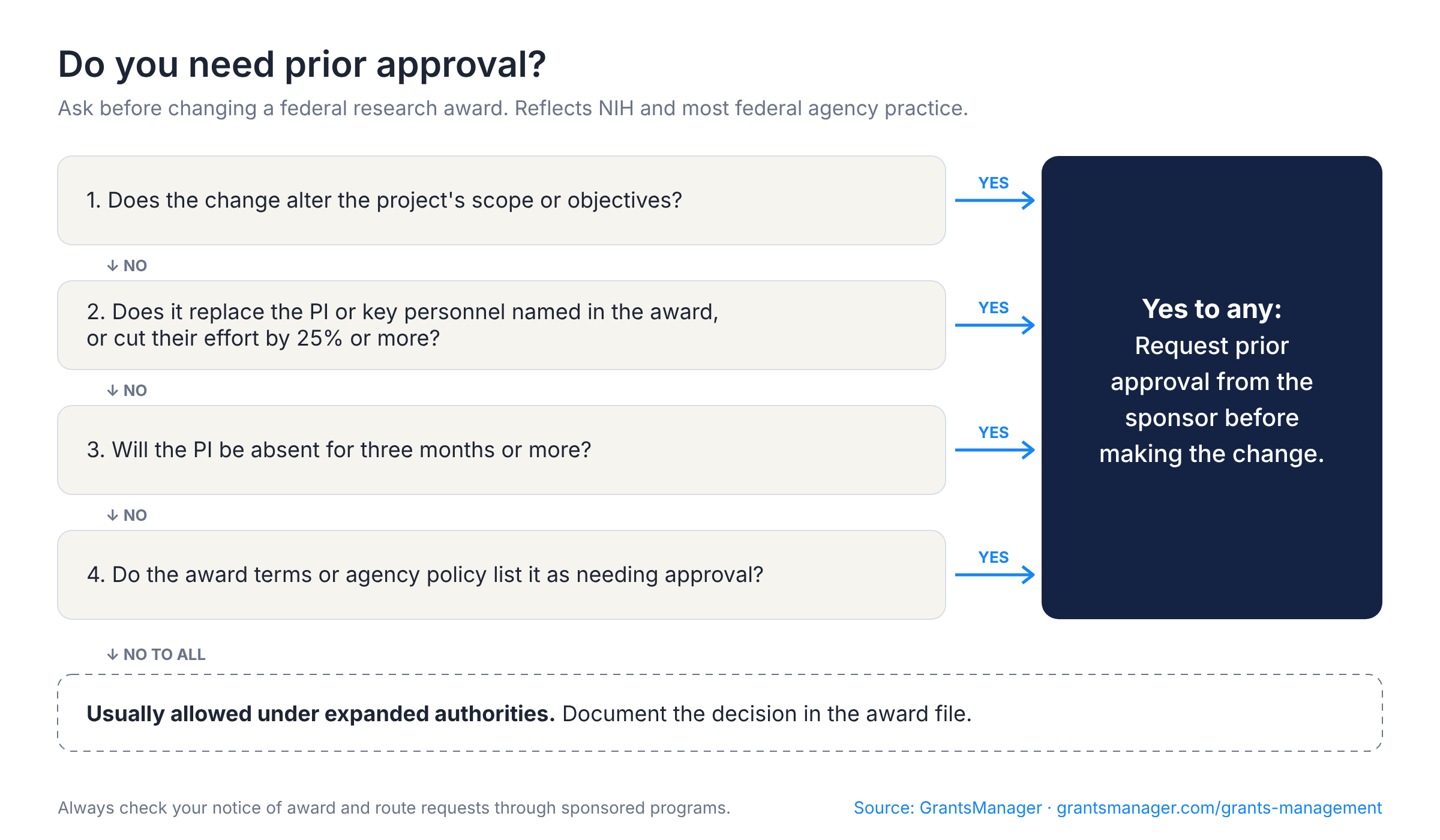
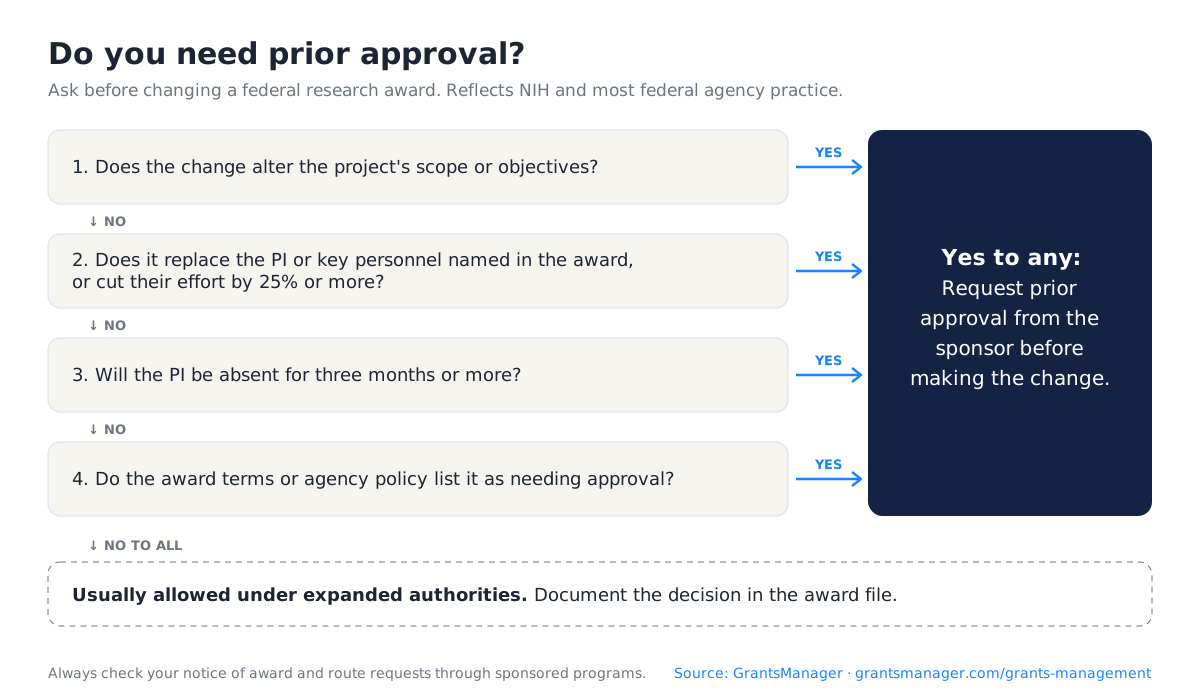
This reflects NIH and most federal agency practice. Always check your notice of award, and route requests through the sponsored programs office. See rebudgeting and change in scope for more detail.
Grants management best practices
Most problems found at closeout or audit started as small issues months earlier. These habits catch them while they are still easy to fix.
- Read the whole award. Including the terms it incorporates by reference, before the first dollar is spent.
- Review spending monthly. Include encumbrances, and compare the share of funds committed with the share of time elapsed.
- Put every deadline on a calendar with an owner. Progress reports, effort certifications, and protocol renewals, at least 30 days ahead.
- Keep one shared record. The PI and the grants manager should work from the same numbers, not separate spreadsheets.
- Ask before you change. Request prior approval before the change happens, not after.
- Fix charges early. Make cost transfers within your institution's window, with a clear justification.
- Monitor subrecipients. Assess risk when the subaward is issued and review every invoice. The subrecipient monitoring checklist covers the requirements.
- Plan closeout early. Start 90 days before the end date, including any extension request.
Common grant audit findings
Organizations that spend $1,000,000 or more in federal awards in a fiscal year need a single audit, and agencies can review awards at any time. The same issues come up again and again in research audits, and almost all of them are preventable with a monthly review.
| Finding | How to prevent it |
|---|---|
| Unsupported effort | Certify effort on time and reconcile it with payroll (effort reporting guide) |
| Unallowable costs | Review charges monthly against the cost principles in 2 CFR 200 |
| Late cost transfers | Correct errors within the institutional window, with a justification |
| Weak subrecipient monitoring | Assess risk at issuance and review every invoice |
| Procurement gaps | Follow the procurement standards and keep quotes |
| Late reports | Calendar every report with an owner, 30 days ahead |
Grant management checklist
Use this checklist for each award, or as a quick review with the PI at each stage.
Before submission
- Budget matches the justification and the sponsor's format
- Internal approvals and cost share commitments signed
- IRB, IACUC, export control, and conflict of interest needs identified
At award
- Terms, special conditions, and report dates recorded
- Account and budget match the award
- Subawards issued with a risk assessment on file
During the award
- Monthly review of spending and burn rate
- Effort certified on schedule
- Prior approvals requested before changes
- Progress reports submitted on time
At closeout
- Final reports filed (NIH: within 120 days)
- Subrecipient final invoices collected
- Account reconciled and records retained
Grants management tools and software
Small portfolios can be run from spreadsheets, but they drift apart as the number of awards and people grows. Most research institutions use a combination of their financial system, sponsor portals such as eRA Commons and Research.gov, and a shared tool for budgets and deadlines. Free tools can cover individual steps: grant calculators for salary, effort, F&A, and burn rate, grant templates for budgets and letters, and the forms and systems directory for each sponsor.
Grants management software such as GrantsManager brings the pieces together: every award's budget, spending, deadlines, and approvals in one record that PIs and research administrators share.
Frequently asked questions
What is grants management?
Grants management is the administration of a grant from the search for funding through closeout: proposals and budgets, award setup, spending and effort, compliance with sponsor and federal rules, progress and financial reporting, and final closeout.
What are the stages of the grant lifecycle?
Four stages: pre-award (finding funding, budgeting, and submitting), award setup (accepting the award and setting up the account), post-award (spending, effort, reporting, and approvals), and closeout (final reports and reconciliation).
What is the difference between pre-award and post-award grants management?
Pre-award covers finding funding, preparing the budget and proposal, and submission. Post-award starts with the notice of award and covers spending, effort, reporting, prior approvals, and closeout. Many institutions split these between a pre-award office and a post-award or grants accounting office.
What does a grants manager do?
A grants manager, often called a research administrator at universities, builds budgets and prepares proposals, sets up awards, reviews spending and effort monthly, prepares prior approval requests, keeps reports on schedule, and reconciles the award at closeout.
What regulations govern federal grants management?
The Uniform Guidance at 2 CFR 200 sets the government-wide rules for administering federal grants. Agencies add their own terms, such as the NIH Grants Policy Statement and NSF's PAPPG, and each notice of award can add special conditions.
When are NIH closeout reports due?
The Final Federal Financial Report, Final RPPR, and Final Invention Statement are due within 120 calendar days of the end of the period of performance. If reports are still missing a year after the end date, NIH closes the award unilaterally.
What does grants management software do?
It keeps each grant's budget, spending, deadlines, approvals, and documents in one shared record, so PIs and research administrators work from the same numbers instead of spreadsheets and email.
- 2 CFR Part 200: Uniform Administrative Requirements, Cost Principles, and Audit Requirements (eCFR)
- NIH Grants Policy Statement 8.6: Closeout
- NIAID: Check an opportunity for the earliest start date
- NSF Proposal & Award Policies & Procedures Guide
- NIH NOT-OD-26-072: Implementation of Uniform Administrative Requirements (April 2026)
- Federal Register: Regulation for Federal Financial Assistance (proposed rule, May 29, 2026)
Manage every award in one place
Budgets, spending, deadlines, and approvals for every award, shared by PIs and research administrators.
Request a demo